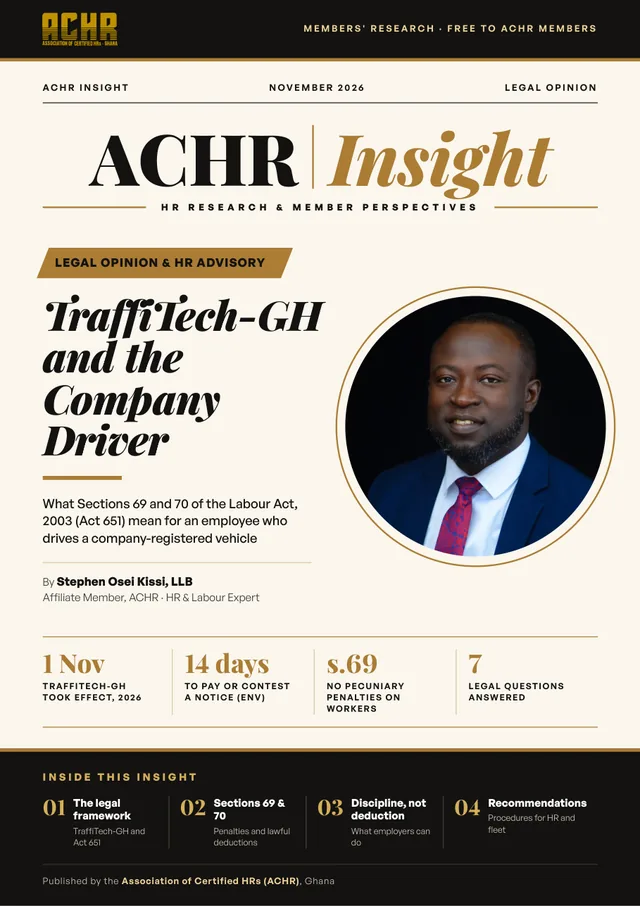

A formal legal opinion and HR policy advisory on what TraffiTech-GH means for employers whose vehicles are driven by employees.
The Ghana Police Service introduced TraffiTech-GH, an automated traffic enforcement system, with effect from 1 November 2026. Arguments made in support of the system include improving road safety and driver discipline on the road.
The implementation forms part of Ghana’s revised road traffic regulatory framework, embodied in the Road Traffic (Amendment) Act, 2025 (Act 1153) and the Road Traffic Regulations, 2026 (L.I. 2519).
The Ministry of Transport explains that the revised framework provides for automated enforcement, speed and red-light cameras, a driver demerit-point system, and increased penalties for certain offences.
The Ghana Police Service explains that TraffiTech-GH uses cameras, sensors and other enforcement devices to capture traffic violations. Electronic Notices of Violation (ENVs) are issued after police validation. An important feature of the system is that camera-generated notices are sent to the registered vehicle owner, who is liable under the applicable framework regardless of who was driving.
This creates a significant issue for employers whose vehicles are driven by employees. When a company vehicle is involved in a traffic violation, the company may receive the notice and incur the immediate statutory payment obligation, even though the alleged offence was committed by its employee. The question therefore arises whether the employer can transfer that financial burden to the employee.
This opinion addresses seven principal questions:
| Legislation | Relevant provision | Subject |
|---|---|---|
| Labour Act, 2003 | Section 8 | Rights of employers |
| Labour Act, 2003 | Section 9 | Duties of employers |
| Labour Act, 2003 | Section 11 | Duties of workers |
| Labour Act, 2003 | Sections 63–64 | Termination and justification |
| Labour Act, 2003 | Sections 67–70 | Protection of remuneration and deductions |
| Road Traffic (Amendment) Act, 2025 | Act 1153 | Revised traffic enforcement framework |
| Road Traffic Regulations, 2026 | L.I. 2519 | Traffic enforcement procedures and penalties |
A key caution: these statutory texts should be read together, rather than interpreting Section 69 in isolation.
Section 69(2): An employer shall not (a) impose a pecuniary penalty upon a worker for any cause whatsoever; or (b) deduct from remuneration due to a worker, any amount whatsoever, unless the deduction is permitted by section 70 or by any other law or is by way of repayment of an advance of remuneration lawfully made by the employer to the worker.Labour Act, 2003 (Act 651)
This provision establishes two distinct legal protections.
An employer cannot impose a monetary punishment on an employee simply because the employee has breached an employment rule. A rule that every driver caught speeding must pay GH¢500 to the company as an internal fine would raise a direct issue under Section 69(2)(a).
Section 69(2)(b) protects remuneration from deductions that lack statutory authorisation. A traffic violation does not automatically entitle the employer to recover the amount from salary. The employer must establish a lawful basis.
The protection under Section 69 applies whether the employee is a permanent, temporary, casual or part-time worker, provided the individual qualifies as a worker under the Act.
Section 70 is the statutory exception to the general prohibition in Section 69. Section 70(1) provides that an employer may, with the consent of the worker, make specified deductions from remuneration. These include:
Section 70(2) imposes additional safeguards on such deductions. The employer must be satisfied that:
Section 70(1)(e) concerns losses suffered by the employer from loss of or damage to property or things used in the employer’s business and under the worker’s control. A statutory speeding fine is not automatically equivalent to physical damage to company property.
A driver damages a company vehicle through negligent driving, established by investigation.
A driver receives a speeding violation while driving a company vehicle. The fine alone does not establish loss or damage to company property.
Accordingly, I would advise against relying on Section 70(1)(e) as blanket authority for deducting all TraffiTech-GH fines from employees’ remuneration.
An employer may seek a deduction in compliance with an order of the National Labour Commission. However, the Commission’s order must be obtained, and the statutory safeguards in Section 70(2) must be observed. Asking an employee to sign a deduction authorisation does not create an entitlement to recover every category of traffic fine.
Not necessarily. Section 70(1) requires worker consent for the specified deductions, but consent does not turn an otherwise prohibited financial punishment into a lawful deduction. A general contractual provision that an employee will bear all traffic fines is therefore not, on its own, sufficient assurance that a later payroll deduction is lawful. This distinction should be reflected in employment contracts and vehicle-use policies.
This distinction is central to TraffiTech-GH. The Ghana Police Service’s official FAQs state that a camera-generated notice is sent to the registered owner of the vehicle, and that the registered owner remains liable regardless of who was driving.
| Registered owner | Employee driving | Traffic fine | Notice recipient |
|---|---|---|---|
| SOK Ltd | Mr K | GH¢240 | SOK Ltd |
Liability under road traffic legislation and liability under employment law are not necessarily identical. The employer’s duty to pay a traffic fine does not automatically establish an employee’s debt to the employer. Equally, the fact that the employee was driving does not make the employee immune from disciplinary action or any independent legal liability.
This requires a careful approach. Section 69 primarily regulates pecuniary penalties imposed by employers and deductions from remuneration. It does not necessarily extinguish every independently enforceable civil obligation an employee might have. However, an employer seeking reimbursement would need to establish a proper cause of action: the employee’s relevant duty, breach, causation and recoverable loss.
Imposing a penalty for misconduct
Seeking a legally recoverable loss
Deducting an amount from remuneration
These are not interchangeable. Where an employee deliberately uses a company vehicle in breach of clear instructions and causes an identifiable loss, the employer may have grounds to investigate a potential civil claim. But a traffic fine imposed on the registered owner does not automatically establish that the employee owes the employer that amount.
Employers should not treat a traffic fine as an automatically recoverable employee debt. Before pursuing reimbursement outside payroll, they should obtain Ghanaian legal advice on the traffic legislation, the employment contract, the employee’s conduct and the legal basis of the proposed claim.
Yes. Section 69 does not remove the employer’s right to discipline workers. Section 8 recognises the employer’s right to discipline, transfer, promote and terminate the employment of a worker, subject to the Act. Section 9 requires employers to maintain adequate disciplinary procedures. Section 11 places duties on workers, including exercising due care, obeying lawful instructions and protecting the employer’s interests. Section 63 addresses termination, including for proven misconduct, subject to the applicable requirements.
Employers may therefore introduce proportionate disciplinary measures:
A written warning is not a pecuniary penalty. An arbitrary GH¢500 disciplinary fine is.
| Employment situation | Legal position |
|---|---|
| Employee driving a company vehicle | Company may receive the ENV; employee may face disciplinary action |
| Employee driving a personal vehicle for work | Registered-owner liability must be considered separately from employment responsibility |
| Commercial driver employed by a transport company | Company should establish the facts and follow lawful disciplinary procedures |
| Driver repeatedly speeding | Repeated misconduct may justify proportionate disciplinary action |
| Driver causes physical damage to company property | Section 70(1)(e) may be relevant, subject to its requirements |
| Employer automatically deducts traffic fine | Potential breach of Section 69(2)(b) |
| Employer imposes additional monetary penalty | Potential breach of Section 69(2)(a) |
Official Police guidance currently requires payment, or the start of a contest, within 14 days of the ENV being issued. Contests are started online, and the Police then arrange the hearing process.
These measures help companies establish who was driving and respond appropriately when a violation is recorded.
I recommend that management take the following steps before implementing or enforcing any new traffic-related employee payment policy.
| Priority | Recommended action |
|---|---|
| 1 | Review existing employment contracts for traffic-fine recovery clauses. |
| 2 | Suspend automatic salary deductions for traffic fines pending legal review. |
| 3 | Review the employee handbook and disciplinary policies. |
| 4 | Introduce the proposed traffic violation management policy. |
| 5 | Train drivers and fleet supervisors on TraffiTech-GH. |
| 6 | Establish an electronic traffic notice register. |
| 7 | Obtain legal advice on any proposed employee reimbursement arrangement. |
For a company operating a substantial fleet, I recommend obtaining a specific legal determination on the following:
Section 69 expressly regulates employer-imposed pecuniary penalties and deductions from remuneration. The line between a genuine, independently enforceable reimbursement claim and an unlawful financial punishment needs careful legal examination.
A contractual undertaking cannot override mandatory statutory protections. Its enforceability will depend on its substance, the circumstances and the applicable statutory provisions.
The registered owner’s liability to the enforcement authorities must be distinguished from any independent claim the employer may have against the employee.
These questions should not be resolved merely by inserting a blanket recovery clause into an employment contract.Stephen Osei Kissi
TraffiTech-GH creates an important new compliance obligation for employers, but it does not displace the protections the Labour Act gives employees. Section 69(2)(a) prohibits employers from imposing pecuniary penalties on employees, and Section 69(2)(b) prohibits unauthorised deductions from remuneration. Section 70 provides limited exceptions, which must be interpreted according to their precise statutory conditions.
Employers should therefore distinguish between:
The practical legal position is that an employee can be held accountable for proven traffic-related misconduct without automatically becoming liable to reimburse the employer for every traffic fine.
Before management adopts the proposed policy, have a Ghana-qualified employment lawyer verify the relevant provisions of L.I. 2519, the precise liability of registered vehicle owners, and any applicable judicial or National Labour Commission decisions on deductions and recovery of employee-related losses. This matters because Section 70(1)(e) and Section 70(1)(f) provide different legal routes and should not be treated as interchangeable.
Stephen Osei Kissi, LLB, is an HR and labour expert and an affiliate member of the Association of Certified HRs (ACHR).
This Insight is general guidance, not legal advice for a specific situation. Employers should seek advice from a Ghana-qualified lawyer before acting on it.