
In an era of intense competition, rapid technological change and shifting workforce expectations, organisations no longer succeed simply by hiring people. They succeed by hiring the right people, with the right capabilities, at the right time, to deliver clearly defined business objectives.
This reality has elevated talent acquisition from an administrative HR function to a strategic business imperative.
Yet many organisations, particularly across Ghana and parts of Africa, continue to experience persistent talent challenges. These challenges are often blamed on skills shortages or labour market constraints. In reality, the deeper issue is frequently a lack of clear, documented and well-researched business strategy. When strategy is weak or unclear, talent acquisition inevitably becomes reactive, misaligned and ineffective.
Talent acquisition is a strategic and systematic process of identifying, attracting, selecting and retaining talent to meet both current and future organisational needs. Unlike traditional recruitment, which focuses on filling immediate vacancies, talent acquisition is long-term, forward-looking and closely linked to where the organisation intends to go.
The fundamental question: what people and capabilities does the organisation need to execute its strategy successfully?
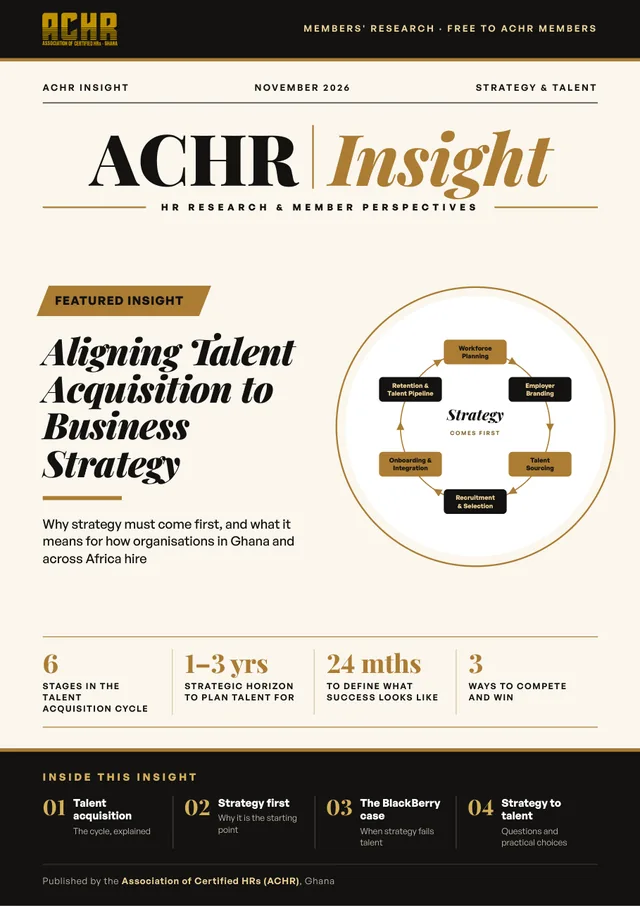
An effective talent acquisition framework typically follows a structured cycle, with strategy at its centre:
When this cycle operates independently of business strategy, recruitment becomes transactional and short-sighted. When aligned, it becomes a powerful driver of competitive advantage.
Talent acquisition cannot be aligned to business strategy unless a business first has a clear strategy. In simple terms, an organisation must know:
A major challenge facing many businesses in Ghana and across Africa is that strategic direction is often:
Many strategies are formed without a proper SWOT analysis (strengths, weaknesses, opportunities, threats) or PESTLE analysis (political, economic, social, technological, legal and environmental factors). When strategy is poorly developed, it creates downstream problems across the organisation, including in talent acquisition.
The decline of BlackBerry offers a powerful lesson in the relationship between strategy and talent.
In the late 2000s, BlackBerry dominated the smartphone market, particularly among corporate users, with secure devices and physical keyboards. Leadership believed that business users would never abandon physical keyboards for touchscreen phones. This assumption became the foundation of their strategy.
As the market shifted toward touch-based devices, app ecosystems and consumer-driven innovation, BlackBerry failed to adapt. The strategic rigidity had a direct impact on talent acquisition. Talented engineers, designers and software developers gravitated toward Apple and Android, companies seen as shaping the future.
BlackBerry increasingly struggled to attract top-tier talent, not because of weak recruitment processes, but because innovative professionals wanted to work on forward-looking technologies, not declining ones.
The lesson is clear: when strategy is wrong, talent acquisition fails, regardless of how strong HR systems may be.
For talent acquisition to truly support business objectives, HR and leadership must clearly understand the organisation’s strategic direction. This requires answering critical questions such as:
The answers to these questions provide the foundation on which an effective talent acquisition strategy can be built.
Consider a business whose strategic priority is to expand operations into other African countries within the next three years. That strategic decision immediately shapes talent acquisition choices.
Questions arise around training, relocation benefits, cultural adaptation and compliance with local labour laws.
The organisation must build an employer brand that attracts talent in the new market, and design onboarding that integrates new hires into its culture.
Without a clear business strategy, these decisions become fragmented and inconsistent. With strategic clarity, talent acquisition becomes deliberate, coordinated and aligned with long-term objectives.
Aligning talent acquisition to business strategy is no longer optional. Organisations that treat recruitment as a reactive, administrative activity will continue to experience skills gaps, poor hires and high turnover.
Conversely, organisations that invest time in developing clear, research-driven strategies create the conditions for effective talent acquisition. The most capable professionals are attracted to organisations with vision, direction and a compelling future.
The central message for businesses in Ghana, Africa and beyond is simple but profound: get the strategy right, and talent acquisition becomes a competitive advantage. Get it wrong, and even the best recruitment systems will fail.
Papa Owusu Bonsafo Bawua, LLB, is a member of the Association of Certified HRs (ACHR) and Head of Consulting and Program at the HR Certification Centre.
The Association of Certified HRs (ACHR) is a professional community of HR practitioners in Ghana, bringing together graduates of the HR Certification Centre’s programmes and other HR professionals. ACHR Insights share members’ views and research on issues shaping the world of work.