
What HR practitioners want from the new Labour Law, and what the Labour Bill, 2024 proposes.
Home › Research & Insights › Paternity Leave in Ghana
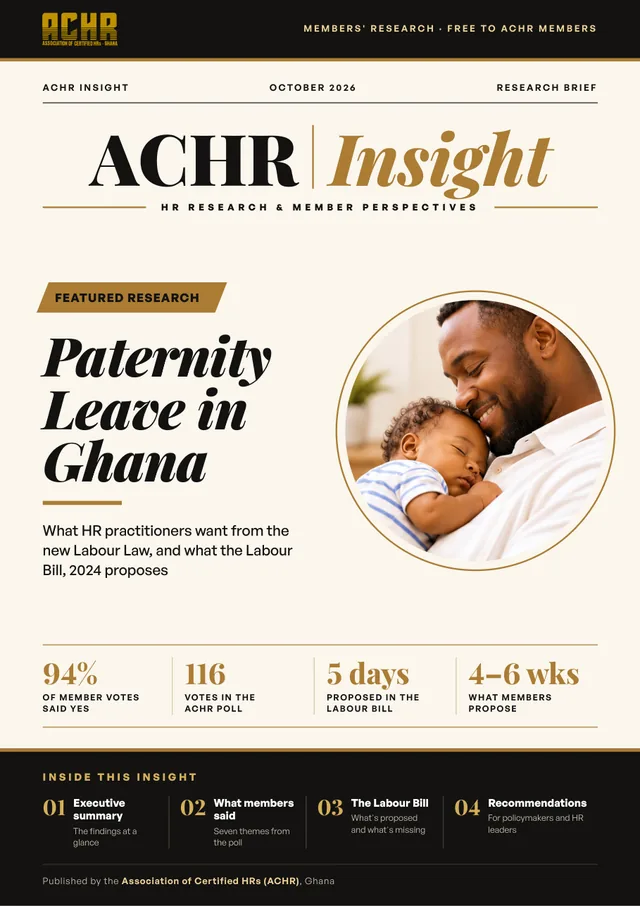
Ghana’s Labour Act, 2003 (Act 651) gives fathers no paternity leave. The Revised Labour Bill, 2024 would introduce it for the first time, at not less than five days. ACHR asked its members whether men should be granted paternity leave, and 94% of the votes said yes.
Members’ comments went further than the Bill. Many argued for four to six weeks, and they raised issues the Bill does not address. International research supports them: leave of two weeks or more is linked to fathers staying involved in childcare long after the leave ends.
When a child is born in Ghana, the law gives the mother 12 weeks of paid maternity leave. It gives the father nothing. Whether he spends time at home depends on his employer’s goodwill, a collective agreement, or his own annual leave.
That may soon change. The Revised Labour Bill, 2024 proposes the country’s first statutory paternity leave. As at February 2026 the Bill had not been passed, and in 2025 a new committee was reviewing the labour law amendments.
With the law still open to review, ACHR asked its members a simple question: Should men be granted paternity leave? This Insight sets out what they said, what the Bill proposes and what the research says, and closes with recommendations for policymakers and employers.
For certified HR practitioners, the question is no longer whether fathers should get leave. It is how much, on what terms, and how to make sure it is used well. The discussion that followed raised seven serious themes.
The first few weeks with a new born are very hectic for the mother… She also needs that emotional support and feeling that she’s not alone in this journey.ACHR member
A grandmother’s help is valuable, “but sometimes they need the presence of the man.” Leave also lets the father bond with the baby. Members proposed four to six weeks.
If the mother dies and only the baby survives, the father should receive the full maternity period. The Bill does not address this. It was the most important gap the discussion surfaced.
Members asked whether HR would need to confirm the “legal wife”, and whether some men might claim repeatedly for children with different partners. Others replied that the child’s birth certificate is enough.
Sceptics noted that many fathers “neither know how to put the diaper on the child nor the child’s teachers name.” Others answered that fathers will “start learning” once they have time at home.
Weekday work, weekend overtime and relocations limit many fathers to “paying bills”. Executives and business owners already have flexibility that ordinary workers lack.
A call for “PTA leave” for fathers drew support and pushback. Critics said school meetings come with notice and can be covered by planning or annual leave.
Some Ghanaian companies already give fathers about a week. Members also cited shared parental leave abroad, such as New Zealand’s Parental Leave and Employment Protection Act 1987.
“It is time our laws are amended to enable daddies be part of their children’s day to day affairs.”
ACHR MEMBERThe Labour Act, 2003 (Act 651) provides 12 weeks of paid maternity leave and no paternity leave. The Revised Labour Bill, 2024 (draft of 28 March 2024) would change this.
| Provision | Labour Act, 2003 | Labour Bill, 2024 |
|---|---|---|
| Paternity leave | None | Not less than 5 days (clause 52) |
| Who qualifies | — | A male worker whose wife, or a surrogate of the wife, gives birth; or who adopts a child under one year with his wife |
| When to apply | — | Within 3 months of the birth or adoption |
| Proof required | — | Proof of birth or of adoption |
| How often | — | Not more than once in 24 months |
| Maternity leave | 12 weeks, fully paid | At least 14 weeks, fully paid, plus 2 weeks for abnormal or multiple births (clause 78) |
The Bill is a welcome first step, and its 24-month cap partly answers members’ concern about repeated claims. Three features of clause 52 deserve attention:
Fathers who are not married to the mother are not clearly covered.
Granted “where the employer is satisfied”. Maternity leave is an entitlement.
Clause 78 says maternity leave is on full pay; clause 52 is silent.
International evidence broadly supports ACHR members. Leave of about two weeks or more, ideally paid and reserved for fathers, changes how involved fathers are, and the effect lasts well beyond the leave itself.
Countries that offer paternity leave, averaging about 9 days. The maternity–paternity gap averages 16.7 weeks.
ILO, Care at Work (2022)Fathers who took two weeks or more were more likely to do childcare when children were young.
Huerta et al., OECD (2013)Fathers who took leave did more feeding, nappy changing and night care.
Tanaka & Waldfogel (2007)Quebec’s five “daddy-only” weeks raised fathers’ leave-taking by about 250%.
Patnaik (2019)Uptake among eligible fathers, 1992 to 2004, after a reserved quota.
ILOUNICEF recommends at least six months of paid leave per family, shared between parents.
UNICEF (2019)| Issue | ACHR members | Labour Bill, 2024 | Evidence |
|---|---|---|---|
| Length | At least 4 weeks; some said 6 | At least 5 days | Two weeks or more linked to lasting involvement |
| Pay | Expected to be paid | Not stated | Paid, reserved leave drives uptake |
| Mother dies at birth | Father should get the full maternity period | Not covered | The Bill protects a bereaved mother (clause 78(6)); a matching rule for fathers would be consistent |
| Eligibility | Birth certificate should suffice | Tied to “the wife” | Child-centred eligibility protects every child |
| Proper use | Some doubt fathers will give care | No provision | Leave itself builds caregiving skills |
Five days is a token, not a policy. It covers the hospital stay and the naming ceremony, but not the two-week threshold at which fathers begin to take on daily care. Members’ instinct for four weeks is much closer to the evidence.
Tying leave to “the wife” is the Bill’s weakest point. A benefit meant for the child depends on the parents’ marital status. Many Ghanaian children are born outside formal marriage, and HR officers would be left to judge customary, religious and civil unions. A birth certificate naming the worker as father, with the 24-month cap, would answer members’ concerns more simply.
The bereaved father is left out. The Bill protects a mother who loses her baby. It offers nothing to a father whose partner dies in childbirth and who is left alone with a newborn.
A law alone does not make fathers present. Uptake depends on pay, on managers who respect the leave, and on workplaces that treat it as normal.
ACHR members have spoken clearly: fathers are parents too, and the workplace should make room for them. The Labour Bill, 2024 opens the door, but five days, uncertain pay and a marriage-based test leave it only half open. As the Bill is reviewed, ACHR urges policymakers to align it with the evidence, and encourages HR leaders to set the standard in their own organisations now.
This Insight is based on a poll of ACHR members on the ACHR HR Mentorship platform. Respondents could select more than one option, so vote totals may not exactly equal the number of respondents. Comments were reviewed for substantive themes, and quotations are lightly edited for clarity. The analysis also draws on the Revised Labour Bill, 2024 (draft of 28 March 2024) and published research.
ACHR Insights are free to members. One-off membership: GH₵500 for Certified Members, GH₵300 for Affiliate Members.